

WALTER KERSHAW GUERRILA ARTIST
By Steve Cooke
An element of the Cancel Culture debate is the question of whether art can be separated from its creator.
It can be argued that once an artwork is released, it takes on a life of its own, allowing viewers to engage with it independently of the artist’s personal history or behaviour. Focussing on the intrinsic value of the work itself, on its emotional impact, technical skill, and cultural significance rather than the creator’s flaws.
Conversely, others contend that supporting or celebrating an artist’s work can implicitly endorse their actions, especially if the artist has caused harm. The artist’s personal conduct may shape the interpretation of their work, and audiences may struggle to separate admiration for the art from moral accountability
We recently lost an artist who sits in the centre of this debate, Walter Kershaw, his passing marks the loss of a visionary who believed art belonged not in galleries, but on the streets where people lived their everyday lives. Kershaw’s later life included time in prison, widely reported at the time. While part of his personal history, should they define the artistic legacy he leaves behind - a legacy built on colour, scale, and a belief that art should be woven into the fabric of everyday life? A painter of street murals who was dubbed ‘the LS Lowry of urban art’, ‘Guerilla Artist’ and ‘The First Graffiti Artist’ which is the title of a BBC student film about his work, that went on to win Best Student Film at Cannes in 1976.
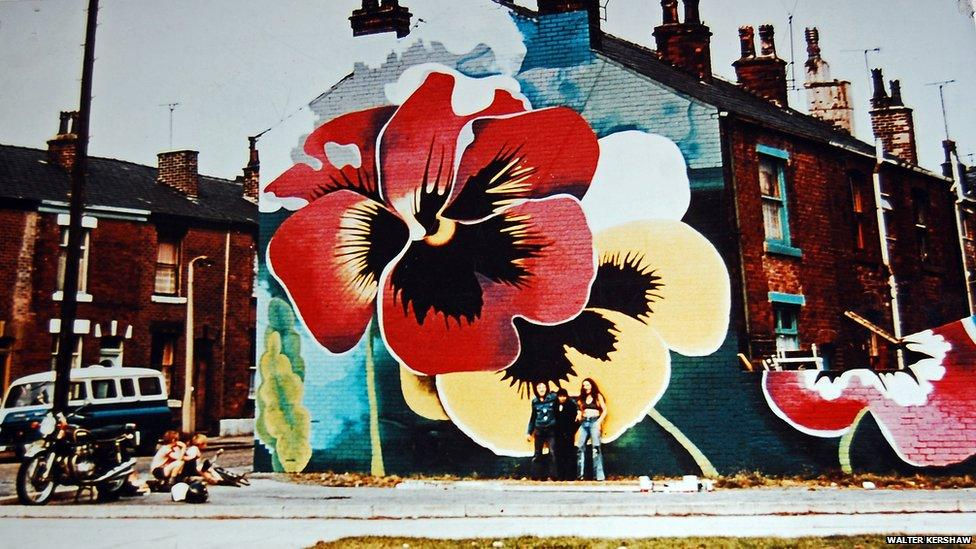
Street murals became his signature from the early 1970s onward. A time when public art was still a rarity, he transformed the gable‑ends of Victorian terraces into huge, colourful canvases that drew national attention. Painted in Rochdale, Bury, Oldham, Manchester and beyond, many have since been demolished or lost through redevelopment. Kershaw never mourned their disappearance but embraced the ephemeral nature of his murals, often choosing condemned properties deliberately so the artwork existed as a fleeting moment of beauty before the bulldozers arrived. A philosophy that public art should live alongside people even if only for a short time.
As a young man Kershaw employed guerrilla tactics to get his murals installed, taking along a motorbike in case of violent exception being taken to his work
Alongside his monumental murals, Kershaw also turned his attention to neglected infrastructure, such as bridges in Burnley, Bury and Rochdale. These structures, often drab and overlooked, became stunning bursts of colour after his interventions.
But not everyone welcomed the transformation. Local authorities issued cease‑and‑desist‑style letters, worried less about the artistic merit and more about the cost of maintenance, undeterred he continued painting.
He frequently worked very early on Sunday mornings, choosing times when few witnesses were around. These clandestine sessions are now considered to be early examples of guerrilla art, long before the term became mainstream.
Kershaw’s work also travelled widely beyond Littleborough, his murals and paintings exhibited across the UK, including at Salford Art Gallery, Bear Lane Gallery in Oxford, and even the House of Commons. His work entered major collections such as the Victoria & Albert Museum and the Arts Council.
He also completed many international commissions, particularly in Brazil, where his large‑scale pieces became part of national collections.
Kershaw’s distinctive approach, blending social commentary, humour, and sheer visual impact, made him a familiar face in the media. He appeared on programmes with Melvyn Bragg and Janet Street‑Porter and once shared a sofa with Eric Morecambe on Russell Harty’s BBC Two show. He became friends with such as George Best and Bob Monkhouse. In 2013 he featured on the BBC's The One Show in a segment with much missed fellow Rochdalian Andy Kershaw.

Even though many of his murals no longer exist, their impact lives on. The stories of his murals and the boldness with which he created them will continue to inspire. Locally we are lucky to still have one of his works above the Coach House on Lodge Street, Littleborough, not far from his studio where I last interviewed him a few years ago. He was still bubbling with enthusiasm and full of thoughts about projects to come. He was certainly a flawed genius.


Comments